x

Unlocking Consumer Preferences with MaxDiff Analysis

Understanding consumer preferences is like solving a complex puzzle. It requires advanced tools to dive deeper into what drives consumer decisions, going beyond basic data analysis. Two powerful methods—MaxDiff and TURF analysis—enable brands to comprehensively understand their audience, allowing them to tailor products and messages with precision.

MaxDiff analysis helps brands prioritise a product or service’s most and least important attributes, enabling more effective resource allocation. TURF analysis, on the other hand, determines the optimal combination of product features or marketing messages that will appeal to the broadest possible audience. These tools complement each other, providing granular insights to help brands refine their strategies for maximum impact.

What is MaxDiff Analysis and How Does it Work?

MaxDiff surveys typically involve multiple rounds, where respondents are asked to choose the most and least important attributes from a set of options. This process produces a ranked list of features based on their relative importance to the target audience. 

For example, an apparel company might use MaxDiff to determine whether fabric quality, sustainability, or price is more important to consumers. The data gathered allows the company to focus on the attributes driving the most value.

What business objectives does MaxDiff address?

  1. Identifying key product features: MaxDiff reveals which features matter most, enabling brands to focus on what will have the highest impact on consumer satisfaction.

  2. Prioritising resources: By understanding which features are most valued, MaxDiff helps brands allocate resources more efficiently.

  3. Guiding product design: MaxDiff assists in determining which features should be prioritised in product development, ensuring alignment with consumer preferences.

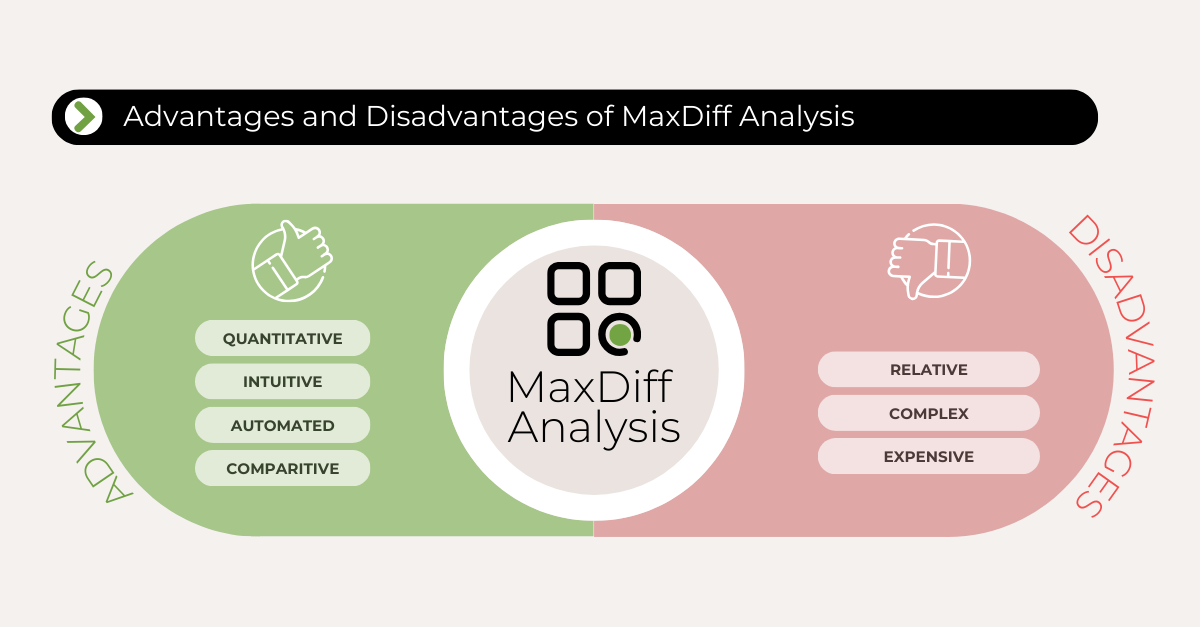
Advantages and Disadvantages of MaxDiff Analysis

Advantages of MaxDiff Analysis: 

      • Accurate prioritisation: MaxDiff forces respondents to make trade-offs between options, leading to more accurate identification of the most and least important attributes. This prevents the common issue of respondents rating many items as equally important, which often occurs with traditional rating scales.
      • Clear hierarchy of preferences: MaxDiff provides a clear, ranked list of attributes based on consumer preferences. This allows brands to see which features are most valued and to focus their efforts on the areas that will have the most significant impact on consumer satisfaction and decision-making.
      • Resource optimisation: By identifying the most critical features, MaxDiff enables brands to allocate their resources more efficiently. Brands can concentrate on the attributes that matter most to their target audience, ensuring better ROI on product development and marketing efforts.
      • Flexibility across industries: MaxDiff is versatile and can be applied across a wide range of industries, from consumer goods to services. It helps brands of all types and sizes understand what drives consumer decisions, making it a widely used tool in market research.

Disadvantages of MaxDiff Analysis:

      • Complex survey design: The structure of MaxDiff surveys can be complex and time-consuming to design. Ensuring respondents are presented with balanced and meaningful trade-offs requires careful planning, which can increase the complexity of the survey development process.

      • Respondent fatigue: Since MaxDiff surveys require respondents to make multiple trade-offs across several rounds, they can be mentally demanding. This can lead to respondent fatigue, especially if the survey is lengthy or if the trade-offs become repetitive, potentially impacting the quality of the data collected.

      • Limited attribute evaluation: MaxDiff works best with a manageable number of attributes. When dealing with a large number of attributes, it can be challenging to structure the survey without overwhelming respondents, which may result in incomplete or inaccurate data.

      • Difficulty in measuring emotional or complex preferences: MaxDiff is highly effective for straightforward, attribute-based comparisons but may fall short when it comes to measuring more complex, emotional, or abstract preferences. It primarily focuses on tangible attributes, which may not capture the full spectrum of consumer motivations.
  •